
The Pancake Problem: Root Cause of Degradation
Aluminum’s extremely high free electron density (~1.8 × 1029 electrons/m³) creates microscopic “mirrors” that reflect over 90% of incident laser energy. This creates the fundamental “pancake problem” – with minimal penetration depth but extreme lateral spread.
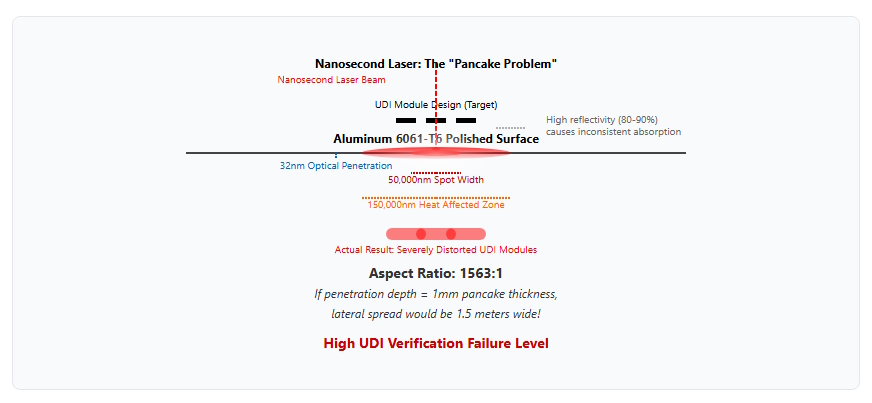
Key Dimensions:
- Optical penetration depth: Only ~32nm (extremely shallow)
- Spot width: ~50,000nm (50 μm)
- Heat affected zone: ~150,000nm (150 μm)
- Aspect ratio: 1563:1 (extremely disproportionate)
Impact on Medical Device Marking
The pancake problem creates UDI marks that are extremely shallow with poor aspect ratios. This shallow penetration depth makes marks vulnerable to degradation in hospital environments, leading to verification failures and potential patient safety issues. Our proprietary 3DLasero technology addresses this fundamental physics problem to create more durable, compliant UDI marks.
The Fundamental Physics Behind the Pancake Problem
Aluminum’s Free Electron Mirror Effect
Aluminum’s extremely high free electron density (~1.8 × 1029 electrons/m³) creates a profound challenge for UDI marking. These free electrons function as microscopic mirrors that reflect over 90% of incident laser energy, particularly at infrared wavelengths.
Most contract manufacturers use standard 1064 nm nanosecond lasers, which significantly worsens this problem as this wavelength is especially prone to reflection from aluminum’s free electrons.

Wavelength Effects
- Standard 1064nm Nd:YAG lasers experience maximum reflection
- Shorter wavelengths (532nm, 355nm) improve absorption
- Longer pulse durations increase heat buildup
- Ultrashort pulses can overcome reflectivity issues
Material Properties
- Thermal conductivity: 167 W/(m·K)
- Melting point: 660°C (1220°F)
- Reflectivity: >90% at 1064nm
- Native oxide layer: 2-5nm Al₂O₃
The Physics Solution
Our proprietary 3DLasero marking technology addresses the pancake problem by using specialized parameter optimization that overcomes aluminum’s fundamental reflectivity challenges. By precisely controlling pulse duration, frequency, and energy distribution, we create marks with significantly improved aspect ratios and durability for medical device applications.
UDI Mark Degradation in Hospital Environments
Degradation Mechanisms Across All Cycles
Initial Condition:
- Shallow UDI marks (~32nm depth) due to pancake effect
- Mark boundaries have structurally weak transition zones
- Al₂O₃ layer forms but has defects at mark edges
Early Degradation (Cycles 1-5):
- Autoclave steam (121°C, 15 PSI) penetrates boundary defects
- Thermal cycling causes differential expansion between areas
- Cl⁻ ions attack Al₂O₃ at boundaries
Progressive Degradation (Cycles 5-10):
- Pitting corrosion at boundaries progresses inward
- Formation of aluminum hydroxide expands volume
- Roughening of mark surface reduces contrast
Severe Degradation (Cycles 10-25):
- Complete module edge degradation with extensive pitting
- Surface porosity develops as corrosion penetrates deeper
- Module boundaries blur beyond design parameters
- Contrast ratio falls below verification threshold
Autoclave Environmental Factors
Hospital autoclave environments create uniquely challenging conditions:
- High-pressure steam (121°C, 15 PSI) penetrates mark boundaries
- Thermal cycling stress creates microfractures
- Condensation concentrates at surface irregularities
- Oxygen-rich environment accelerates oxidation reactions
- Repeated cycles create cumulative material fatigue
Chemical Cleaning Impact
Hospital-grade disinfectants create aggressive environments:
- Chlorine-based cleaners attack aluminum oxide
- Acidic cleaners (pH 2-5) dissolve aluminum oxide
- Electrochemical cells form between UDI mark areas
- Hydrogen peroxide oxidizes aluminum surface
- Quaternary ammonium compounds trap moisture
Our Solution to Degradation
3DLasero’s advanced marking technology creates significantly deeper marks with improved aspect ratios that resist degradation even after 25+ autoclave cycles and harsh chemical exposure. Our proprietary process produces marks with strong oxide layers that maintain FDA-compliant verification scores throughout the entire device lifecycle.