The Titanium Vertical Confinement Paradox
The Paradox: Low Lateral Spread, High Vertical Damage
Unlike aluminum (which suffers from the “pancake effect” of extreme lateral heat spread), titanium presents a counterintuitive challenge: minimal lateral heat spread but severe vertical heat confinement.
This creates a paradoxical situation where the material has minimal lateral spreading but still fails to produce reliable small UDI modules due to vertical thermal distortion and unstable oxide formation.
Titanium’s Critical Properties:
- Thermal Conductivity: 6-7 W/m·K
- vs. Aluminum: ~237 W/m·K
- Thermal Diffusivity: 9.4 mm²/s
- vs. Aluminum:97.5 mm²/s
Vertical Heat Entrapment: What Your Engineers Don’t Know

The Physics Problem:
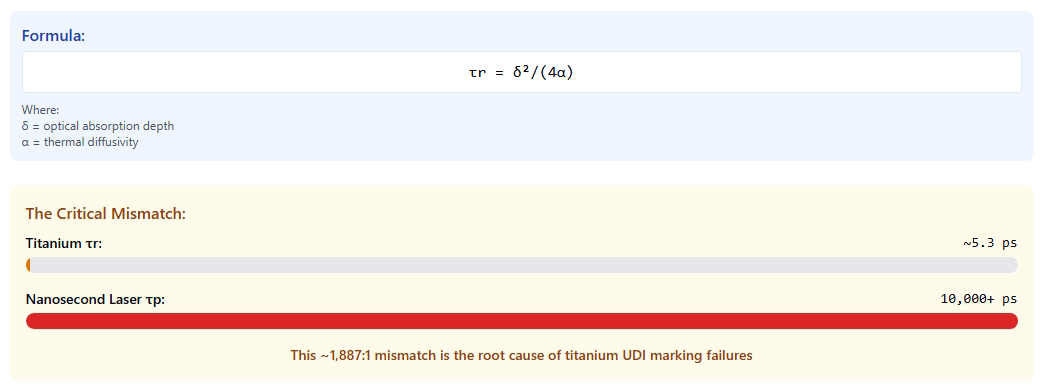
Nanosecond laser pulses (10⁻⁹ s) deliver energy over a timeframe that far exceeds titanium’s thermal relaxation time (τr ≈ 5.3 ps or 5.3 × 10⁻¹² s).
τp (pulse duration) = 10,000+ ps
τr (thermal relaxation) = 5.3 ps
τp/τr ratio = ~1,887:1
Critical Impact on Finder Patterns
Finder patterns (the L-shaped elements in Data Matrix codes) are particularly vulnerable to vertical heat entrapment. These patterns require precise geometric accuracy for scanner recognition. With intense vertical heat retention in small modules, edges become distorted vertically—creating roundness, melting, excessive oxidation, and geometry loss.
This vertical distortion is invisible during initial inspection but becomes critical during scanner verification, especially after autoclave cycles when the unstable oxide layers begin to degrade.
Key Learning:
The titanium paradox reveals that successful UDI marking requires considering both pancake effect and vertical confinement. Materials with low pancake effect can still have severe marking issues due to vertical thermal effects, particularly in critical finder pattern areas.
The Critical Thermal Relaxation Mismatch
Understanding Thermal Relaxation Time
Thermal relaxation time (τr) is a critical material property that defines how quickly heat dissipates from heated zones into surrounding areas. It represents the characteristic time required for the heated volume to dissipate 63% of its thermal energy.