
What Makes Anodizing So Variable?
Root Cause Analysis: Understanding the science behind anodizing variations is critical to avoiding costly marking failures.
How Do Type II and Type III Anodizing Differ?
| Property | Type II | Type III |
|---|---|---|
| Thickness | 10-25 μm | 25-100 μm |
| Hardness | Lower | Higher |
| Porosity | Higher | Lower |
| Color Options | Wide range | Limited (darker) |
Anodizing Variability Impact
Many manufacturers apply identical near-infrared (1064 nm) laser settings across various anodized aluminum surfaces and colors. This one-size-fits-all approach neglects critical differences in oxide thickness, optical absorption, and thermal properties.
Common Industry Challenge:
When medical device manufacturers receive aluminum components, they rarely receive detailed information about the anodizing specifications. Even when they do, these specifications can change silently over time when OEMs switch anodizers or modify processes.
Why Does Reflectivity Matter for Different Wavelengths?
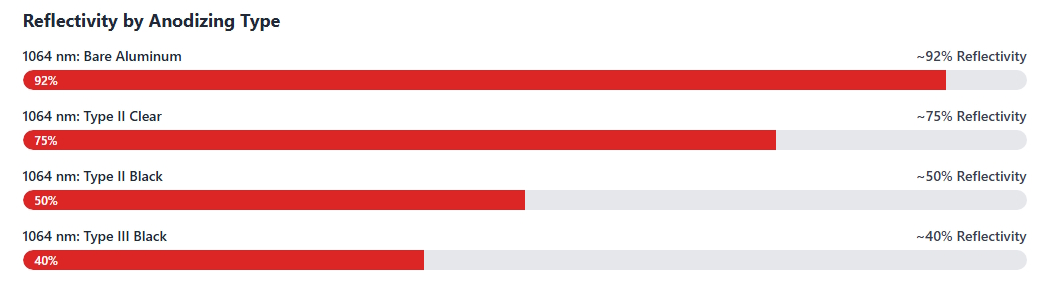
Each anodizing variation creates dramatically different laser absorption rates, requiring precise parameter adjustments to achieve optimal marking results.
Real-World Impact: The Silent Changes
Case Study: Medical Instrument Manufacturer
A leading medical device company spent weeks troubleshooting inconsistent UDI marks after their OEM changed anodizers without notification.
Their technicians tried numerous parameter adjustments without understanding the fundamental issue: they were now working with Type III anodizing instead of Type II, requiring completely different laser settings.
The Invisible Variable
Most manufacturing quality control processes fail to detect anodizing specification changes because:
- Visual inspection can’t reliably distinguish anodizing types
- Thickness measurements aren’t routinely performed
- Reflectivity properties aren’t typically specified
- Communication gaps between OEMs and marking departments