
The Technical Variables in Laser Marking
Why Do Different Variables Matter?
Understanding how these technical variables interact is key to avoiding costly marking failures.
Diagnostic Questions Matrix
Why did the mark suddenly become inconsistent after six months of stability?
This could indicate an unreported material change in your supply chain.
Why does the same part mark differently at different contract manufacturers?
Wavelength, pulse duration, and parameter differences can cause unexpected variability.
Why do some parts in the same batch mark perfectly while others fail?
This often indicates mixed material sources or variations in anodizing process controls.
Our Comprehensive Solutions
Technical Consulting Services
- Comprehensive laser marking process analysis and optimization
- Material characterization and reflectivity testing
- Supply chain vulnerability assessment
- Parameter development for various anodizing types
Training and Implementation
- Operator training on anodizing variation detection
- Engineering support for validation protocol development
- Implementation of automated material verification systems
- Standard operating procedure development
Why Does Reflectivity Matter for Different Wavelengths?
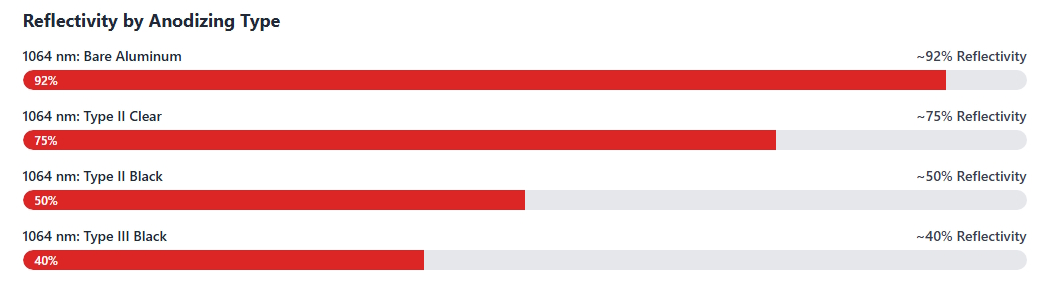
Each anodizing variation creates dramatically different laser absorption rates, requiring precise parameter adjustments to achieve optimal marking results.
Real-World Impact: The Silent Changes
Case Study: Medical Instrument Manufacturer
A leading medical device company spent weeks troubleshooting inconsistent UDI marks after their OEM changed anodizers without notification.
Their technicians tried numerous parameter adjustments without understanding the fundamental issue: they were now working with Type III anodizing instead of Type II, requiring completely different laser settings.
The Invisible Variable
Most manufacturing quality control processes fail to detect anodizing specification changes because:
- Visual inspection can’t reliably distinguish anodizing types
- Thickness measurements aren’t routinely performed
- Reflectivity properties aren’t typically specified
- Communication gaps between OEMs and marking departments