
Why Your Current Laser Marking Process Is Compromising Device Safety
The UDI Compliance Problem
Medical devices marked with standard industry nanosecond lasers frequently experience UDI degradation and corrosion following autoclave cycles.
Common Industry Problems:
- Unexpected corrosion after autoclave cycles
- Loss of mark contrast following sterilization procedures
- UDI mark degradation leading to regulatory non-compliance
- Premature device failure due to corrosion initiation
The Root Cause: Chromium Depletion
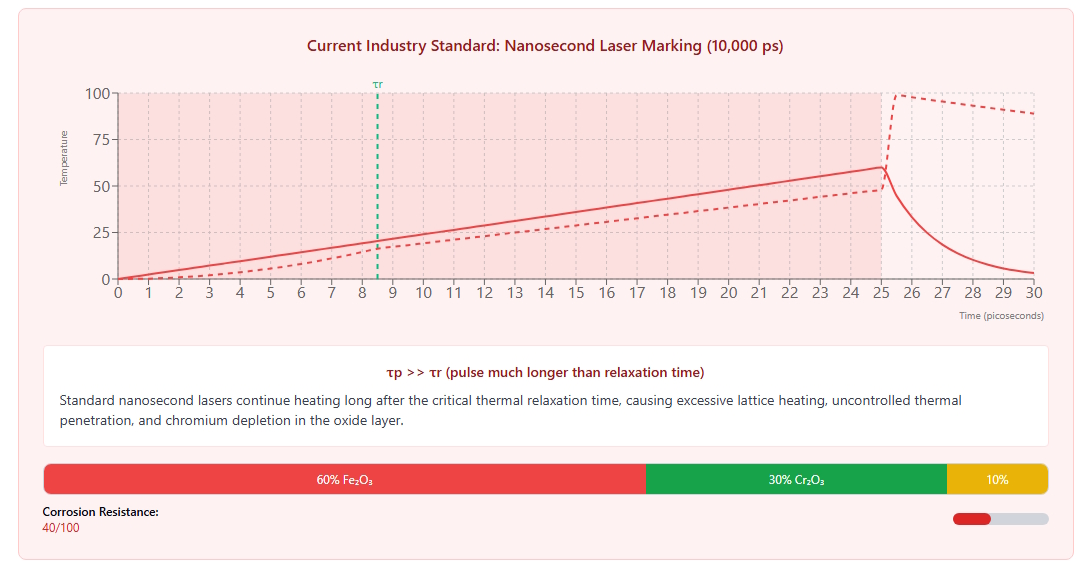
Stainless steel’s corrosion resistance depends on a stable chromium oxide (Cr₂O₃) passive layer. Nanosecond lasers create a chromium-depleted zone around the mark, compromising this protection.
The Science Behind the Failure:
- Thermal relaxation time (τr) is ~8.5 ps for stainless steel
- Nanosecond pulses (10,000 ps) exceed this by 1,000x
- Excessive heat creates iron-rich oxides instead of chromium-rich
- Heat-affected zone extends 15-50μm beyond visible mark
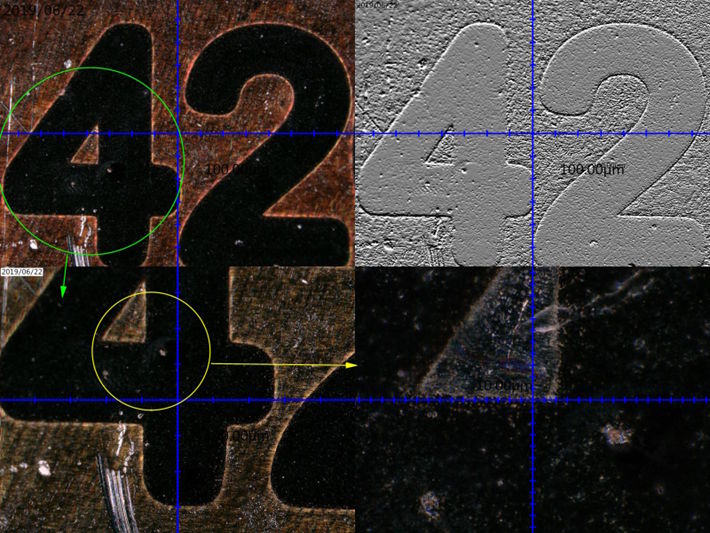
Heat affected zone around laser mark
Failure Mechanism Progression
- 1
Nanosecond Laser Marking
10,000 ps pulse duration - 2
Thermal Penetration
Deep, uncontrolled heat-affected zone, 15-50μm beyond visible mark - 3
Chromium Depletion
Cr₂O₃ layer compromised - 4
Autoclave Sterilization
High temperature + moisture - 5
Corrosion Initiation
UDI mark degradation and failure