
The Science of Module Growth: Why Material Physics Matters
Unraveling the counter-intuitive thermal mechanisms that determine DataMatrix verification success
Module Growth: The Verification Challenge
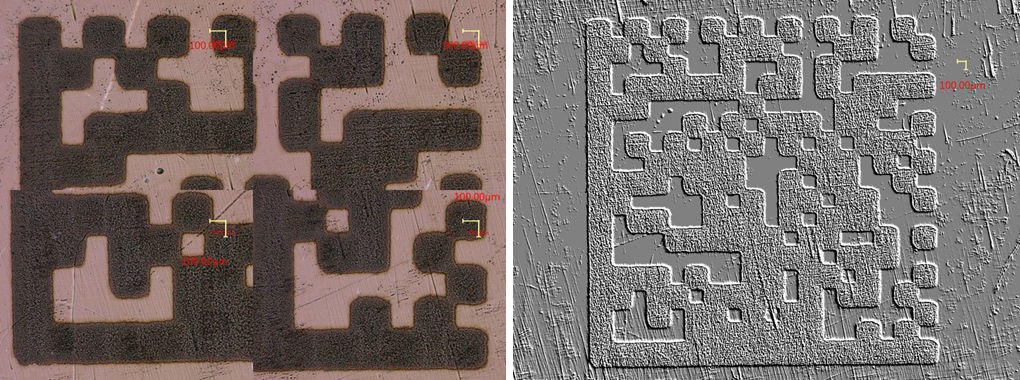
Module Growth is the hidden force behind countless UDI marking verification failures. Unlike simple indexing or alignment issues, this phenomenon creates invisible thermal distortions that can make even perfectly aligned markers fail verification.
The Costly Surprise
Module Growth often appears only after production is scaled, causing expensive recalls and compliance failures that weren’t caught in initial testing.
The Measurement Challenge
Verification equipment measures total module expansion, but can’t distinguish between different mechanisms—making conventional troubleshooting inadequate.
The Material Mystery
Materials respond in profoundly counter-intuitive ways to laser marking, with some high-conductivity materials actually performing worse than expected.
Did You Know?
A difference of just 3-4μm in module growth can be the difference between reliable verification and intermittent failures. Yet most manufacturers focus exclusively on laser parameters while ignoring the crucial material physics at play.
Three Thermal Metaphors: Understanding Materials
To understand Module Growth, we must think of materials through three distinct thermal metaphors, each capturing a different aspect of how heat moves through a material during laser marking.
Thermal Reservoir
How much heat energy a material can absorb before changing temperature dramatically.
Think of it as: Battery capacity (AAA vs AA)
Materials with larger “batteries” resist temperature spikes during marking.
Thermal Highway
How efficiently heat energy can be transported away from hot spots.
Think of it as: Highway lanes and traffic flow
Materials with “wider highways” dissipate heat between pulses but may spread laterally.
Thermal Inertia
Resistance to temperature change regardless of energy input.
Think of it as: Vehicle mass on the highway
Materials with higher “inertia” create more defined module boundaries.
Expert Insight:
Most laser operators incorrectly assume that thermal conductivity is the only material property that matters. In reality, the ratio between conductivity and volumetric heat capacity creates diffusivity, which dramatically alters how modules grow in the nanosecond timescale of laser pulses.
Counter-Intuitive Behaviors Across Materials
Intuition tells us that highly conductive materials like aluminum should create the most precise, well-defined modules due to efficient heat removal. In reality, these materials often create the worst module growth problems.
What explains this surprising behavior? The key is understanding that three distinct growth mechanisms operate simultaneously, each dominant on different timescales and with different materials:
- Pancake-Induced Lateral Growth – Dominated by thermal diffusivity, creating immediate lateral spread
- Vertical Heat-Entrapment Growth – Traps heat near the surface, intensifying the mark within boundaries
- Cumulative Heat Progression – Creates gradient effects across the UDI code as marking progresses
The Hidden Formula:
Our proprietary thermal diffusion analysis shows that for a typical 10ns laser pulse, thermal diffusion length varies dramatically: Ldiff = √(4ατ) ranges from 1.97μm for aluminum to just 0.07μm for PEEK—explaining the paradoxical 28× difference in lateral growth under identical laser parameters.
The Critical Timescale Effect
Module growth physics operates across multiple timescales, with different material properties becoming dominant at each stage of the marking process—creating the seemingly contradictory behavior of different materials.
Nanosecond Timescale
Governed by: Thermal Diffusivity (α)
During each pulse, heat spreads laterally creating the initial “pancake effect” that defines module boundaries.
Best Material: PEEK (0.11 mm²/s)
Worst Material: Bare Aluminum (97 mm²/s)
Millisecond Timescale
Governed by: Thermal Conductivity (k)
Between pulses, heat must dissipate before the next pulse arrives, preventing cumulative thermal buildup.
Best Material: Bare Aluminum (237 W/m·K)
Worst Material: PEEK (0.25 W/m·K)
Second Timescale
Governed by: Temperature Coefficient (β)
As marking progresses across the code, overall substrate temperature rises, creating position-dependent growth.
Best Material: 304 Stainless Steel
Worst Material: Additively Manufactured Titanium
The Highway Traffic Analogy
Understanding the critical difference between thermal properties:
- Thermal Conductivity (k): Like total flow capacity of a highway—how many vehicles can pass through per hour
- Density (ρ) & Specific Heat (Cp): Like the number and load of vehicles on the road
- Thermal Diffusivity (α = k/ρCp): Like the number of lanes—how quickly traffic flow changes propagate
Material Selection Impact
Our proprietary thermal analysis reveals that no single material property can predict UDI marking success. Instead, a balance of all three properties must be considered:
Material Comparison: UDI Marking Performance
| Material | Overall Rating | Primary Behavior |
|---|---|---|
| 420 Stainless Steel | Best overall balance of all three thermal properties | |
| Titanium CP | Excellent module definition with decent heat flow | |
| 304 Stainless Steel | Large thermal reservoir with moderate conductivity | |
| Ti-6Al-4V Alloy | Excellent module definition but strong thermal memory | |
| Anodized Al Type III | Reduced pancake effect compared to bare aluminum | |
| Bare Aluminum | Extreme pancake effect despite excellent highways |
The Ideal Material Balance:
- Large Thermal Reservoir – Prevents temperature spikes during marking
- Moderate Thermal Inertia – Balances module definition vs. heat entrapment
- High-Speed Thermal Highways – Creates thermal isolation between modules
No material perfectly satisfies all requirements, which is why material-specific laser parameter optimization is essential.
Expert Technical Consulting
Module Growth control requires a scientific approach specifically tailored to your materials and UDI marking needs. Our technical team specializes in thermal physics analysis for medical device manufacturers.
Solve Module Growth Problems Permanently
Our technical team delivers material-specific analysis and optimization using proprietary thermal modeling techniques not available elsewhere.